I want to end this series with a painting that might seem lighter than the civil rights work. But look closer.
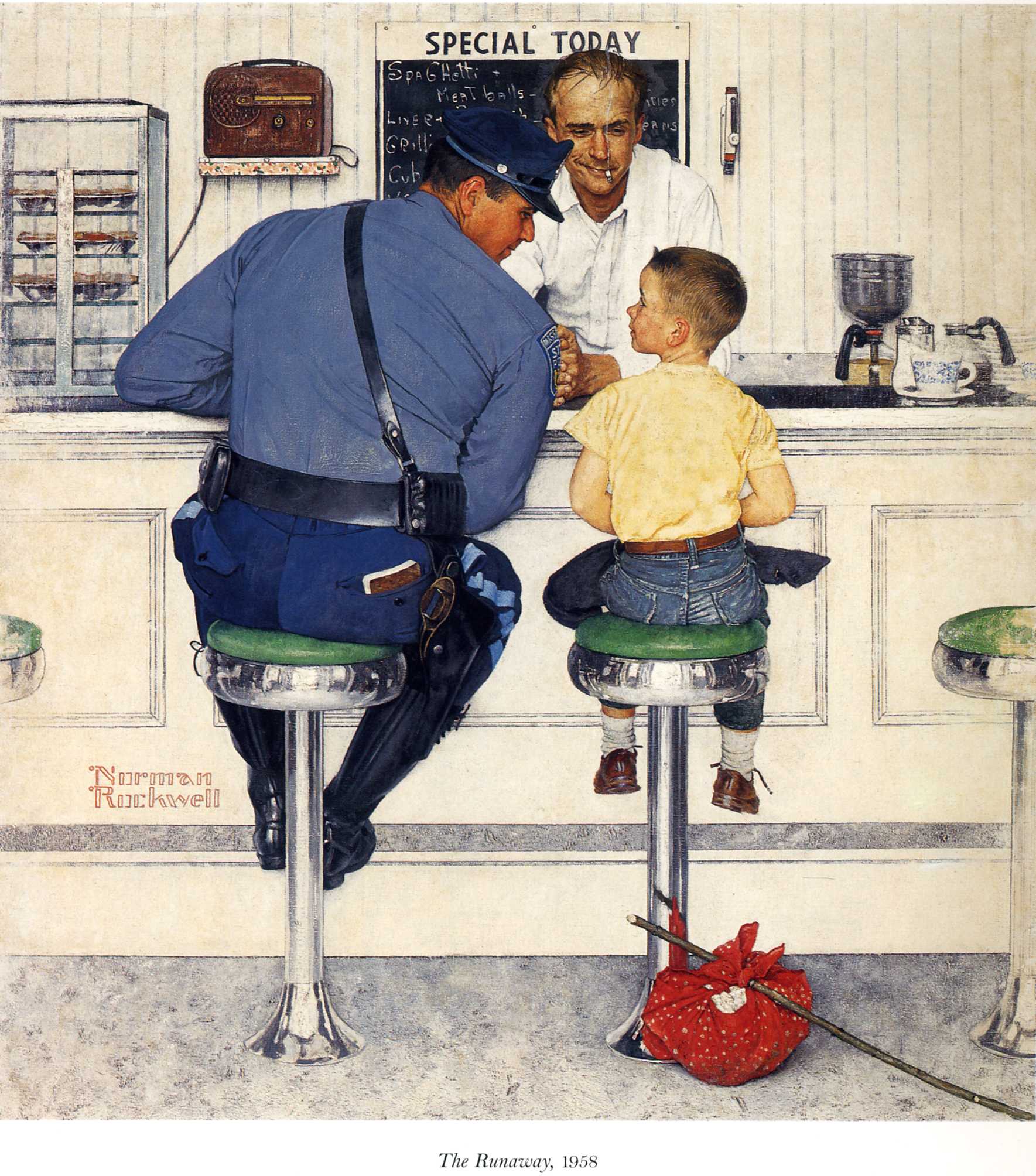
"The Runaway" shows a boy on a diner stool. He's maybe eight or nine. Beside him sits a state trooper. Under the stool: a stick with a bandana bundle tied to the end—the classic runaway's bindle. The counterman leans in, watching the exchange.
Nobody's panicking. Nobody's lecturing. The trooper isn't hauling the kid into the patrol car. He's just sitting there, having a conversation. Meeting the boy where he is.
That's the whole teaching.
Rockwell staged this at a Howard Johnson's in Pittsfield, Massachusetts, though he removed the chain restaurant branding "to suggest the kid had gotten a little further out of town." Richard Clemens, a 30-year-old Massachusetts State Trooper, posed for the officer. Eight-year-old Ed Locke is the runaway.
Look at the composition. The boy is small between the two adults, but he's not cowering. He's being taken seriously. His running away—whatever drove him to pack that bindle and hit the road—is being treated as real, not dismissed as childish drama.
"I showed the America I knew and observed to others who might not have noticed." — Norman Rockwell
This painting shows something we've lost. A community that catches its members when they fall. A world where a state trooper responds to a runaway kid not with force or fear, but with a stool and a cup of coffee and a conversation.
It's idealized, sure. Rockwell admitted he painted life as he wanted it to be. But that's not the same as lying. It's offering a vision. It's saying: This is possible. This is how we could treat each other.
The trooper in this painting is practicing something that looks a lot like mindfulness. He's not reacting. He's not projecting his own fears onto the situation. He's present. He's listening. He's creating space for the boy to figure out his next move without adding pressure.
That's the empty space in action. That's the pause between stimulus and response, made visible.
Norman Rockwell spent sixty years painting America. He showed us our ideals and our failures, our hopes and our shame. He painted Thanksgiving dinners and civil rights martyrs, small-town warmth and national trauma.
But maybe the most important thing he painted was this: two people sitting at a counter, one of them in crisis and one of them just being present. No judgment. No panic. No rush to fix or punish or control.
Just presence. Just witness. Just the space where healing becomes possible.
That's the practice. That's what all of this has been about. Finding the empty space—in ourselves, in our relationships, in our communities—and having the courage to stay there long enough for something real to happen.
Support the Legacy: The Runaway is one of Rockwell's most beloved images—compassion without judgment. Available as a museum-quality print at prints.nrm.org.
Every painting in this series is available from the Norman Rockwell Museum. Your purchase directly supports their mission to preserve his true legacy—especially important now, as the family fights to protect his work from those who would twist it into something he would have despised.
