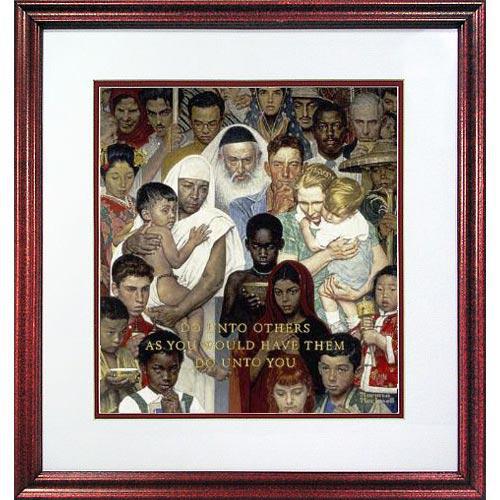
Before Rockwell broke completely with the Saturday Evening Post, he tested the waters. In 1961, he painted "The Golden Rule."
Look at it. Really look.
People of every race. Every religion. Every nationality. Standing together. A Jewish man. A Buddhist monk. African faces. Asian faces. Middle Eastern faces. White faces. Children and elders. All of them framed by one phrase: "Do Unto Others As You Would Have Them Do Unto You."
The Saturday Evening Post published it. Readers loved it. It became one of the most requested prints in the magazine's history. In 1985, then-First Lady Nancy Reagan presented a large mosaic version of The Golden Rule to the United Nations, where it remains a fixture today.
But here's what's interesting: it wasn't controversial.
That should tell us something.
The Golden Rule—the idea that all humans deserve equal treatment—has never been the problem. Almost everyone agrees with it in the abstract. It's the kind of thing people nod along to and then immediately forget when someone who doesn't look like them needs help.
Rockwell understood this. The Golden Rule painting was a warmup. A way of establishing that his values weren't radical—they were universal. Every faith tradition represented in that painting teaches the same thing: your neighbor's suffering is your concern.
The controversial part isn't the principle. It's the application.
It's easy to agree that we should treat others as we'd want to be treated. It's harder to look at a six-year-old Black girl walking into a white school through a gauntlet of screaming adults and ask: "What would I want someone to do for me in that situation?"
Rockwell was building toward that question. He just wasn't ready to ask it yet.
"I unconsciously decided that, even if it wasn't an ideal world, it should be and so painted only the ideal aspects of it." — Norman Rockwell, 1960
He said that in 1960. A year later, he painted The Golden Rule. A few years after that, he'd paint images that shattered his self-imposed limits forever.
The progression matters. You don't go from complicity to courage in one jump. You test the waters. You see what you can get away with. You build your case slowly.
And then, if you're brave, you finally say the thing that can't be unsaid. You paint the picture that can't be unpainted.
Rockwell was almost 70 years old. He'd been playing it safe his entire career. The Golden Rule was him asking himself a question: What would happen if I stopped?
The answer would define his legacy.
Support the Legacy: The Golden Rule print is available from the Norman Rockwell Museum—a perfect reminder that we belong to each other. prints.nrm.org
