There's a Norman Rockwell painting from 1946 called "Boy in a Dining Car." A young white boy sits at a table in a train's dining car, studying the menu with great seriousness. A Black waiter stands beside him, patient and attentive.
Look at the composition. The boy is centered. He's the subject. The waiter is in service position—present but peripheral. That's the only way the Saturday Evening Post would allow Black Americans to appear in Rockwell's work for most of his career.
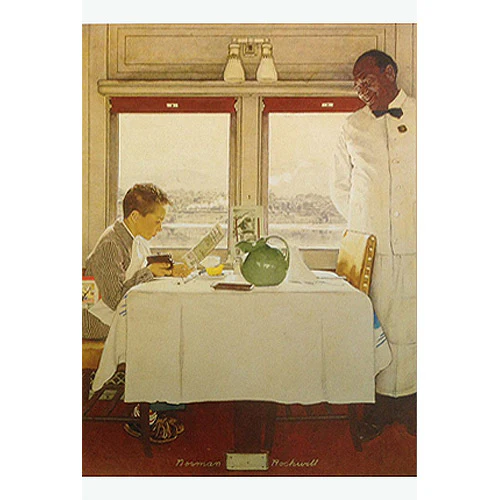
Servants. Porters. Background figures. Never the subject. Never the hero. Never fully human.
This wasn't Rockwell's choice. It was the Post's policy. In interviews later in life, Rockwell recalled being directed to remove a Black person from a group picture because the magazine's policy dictated showing Black people only in service industry jobs. And he went along with it for 47 years.
I'm not here to excuse that.
Part of mindfulness practice is sitting with uncomfortable truths. And here's one: even good people participate in evil systems. Even artists with genuine vision can spend decades looking away from injustice because confronting it might cost them something.
Rockwell knew Jim Crow was wrong. He knew his paintings were showing a white-washed America. He knew every Black face he painted in a servant's uniform was a lie of omission—a refusal to show the full humanity of millions of Americans.
And he kept cashing the checks.
For 47 years.
"I was born a White Protestant with some prejudices that I am continuously trying to eradicate. I am angry at unjust prejudices, in other people and in myself." — Norman Rockwell, 1962
That quote takes on a deeper meaning when you realize his "life as I would like it to be" didn't include Black children going to school. Didn't include Black families at Thanksgiving. Didn't include Black workers as anything but servants to white comfort.
This is what complicity looks like. Not hatred. Not burning crosses. Just... going along. Accepting the limits of the acceptable. Painting within the lines someone else drew.
The reason I'm telling this part of the story is because it makes what came next mean something. Rockwell didn't just wake up one day as an old man and decide to paint civil rights. He spent decades being complicit first.
Recovery works the same way. You don't get credit for the transformation if you pretend there was nothing to transform from. The whole point is that you were part of the problem before you became part of the solution.
Rockwell was part of the problem. For 47 years. And then, in his late sixties, he decided to stop.
What happened next is why we're still talking about him.
Support the Legacy: Museum-quality prints available at prints.nrm.org. Your purchase directly supports the Norman Rockwell Museum.
