After the intensity of Ruby Bridges and the Mississippi murders, Rockwell painted something different. Quieter. More hopeful.
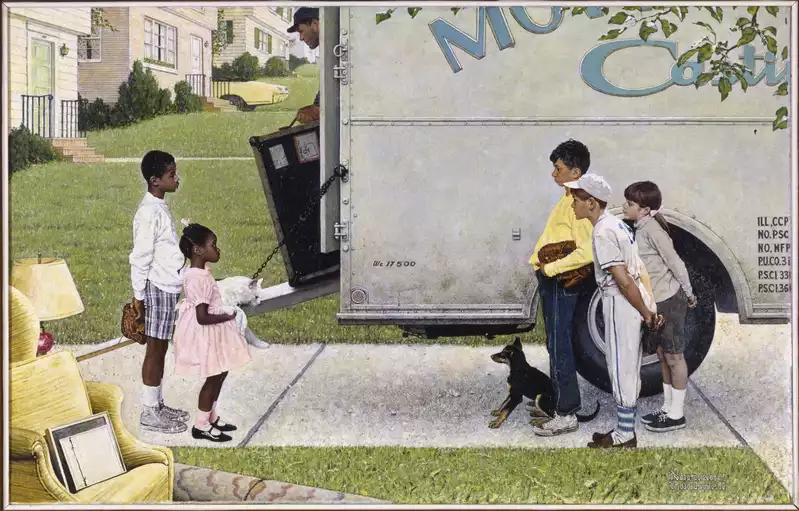
Two groups of children. On one side, white kids with their dog and baseball equipment. On the other, Black children—a moving truck behind them—with their cat. They're staring at each other. Not with hatred. Not with fear. Just... curiosity.
Kids sizing each other up the way kids do.
This is integration as it could be. Not forced. Not violent. Just new people in the neighborhood, and everyone figuring out how to be neighbors.
The painting appeared in Look magazine in 1967. It didn't generate the controversy of Ruby Bridges. No death threats. No burning effigies. And that's the point.
The children in this painting haven't learned to hate yet. The white kids aren't screaming slurs. The Black kids aren't cowering. They're just standing there, looking at each other, probably thinking about whether they can get a game going.
That's not naive optimism. That's observation. Rockwell knew that hatred is taught. He knew that children don't come into the world as segregationists—they have to be made into them by adults who are afraid of change.
"I showed the America I knew and observed to others who might not have noticed." — Norman Rockwell
He'd spent three years showing America its brutality—the marshals escorting Ruby, the bodies in Mississippi. Now he was showing another possibility. Not because he was retreating into nostalgia, but because he understood something about change.
You can't just show people the problem. You have to show them the solution, too. Or at least the possibility of one.
The kids in this painting have a choice. They can listen to the adults around them—absorb the fear, the prejudice, the boundaries that make no sense—or they can pick up the baseball and start playing.
Rockwell doesn't tell us which they'll choose. He just paints the moment before. The empty space where the decision lives.
Sound familiar?
Between stimulus and response, there is a space. These kids are standing in it. So are we, every day. The question is what we do with it.
Do we inherit our parents' fears, or do we put down the baggage and pick up the baseball?
Rockwell was 73 when he painted this. Still working. Still looking. Still finding the sacred pause in ordinary moments. The new kids in the neighborhood aren't just Black children moving to a white street. They're all of us, every time we encounter something unfamiliar and have to decide how to respond.
Curiosity or fear? Connection or separation? The choice is always ours.
Support the Legacy: New Kids in the Neighborhood prints available at prints.nrm.org. Hope, beautifully rendered.
