I've been thinking about Norman Rockwell lately.
Not the Norman Rockwell of coffee mugs and greeting cards. The real one. The guy who spent 60 years looking—really looking—at ordinary people doing ordinary things, and finding the sacred in all of it.
I was born in 1978—the year Rockwell died. As a boy, I saw his paintings of sailors in magazines and books. Old salts with weathered faces. Young men in Navy blues. Something about those images stuck with me. When I enlisted in the Navy years later, I didn't consciously think about Norman Rockwell. But he was there, somewhere in the background, showing me what service could look like—not heroic, just human.
That's mindfulness, by the way. That's the practice. Paying attention to what's actually in front of you instead of what you wish was there or what you're afraid might be there.
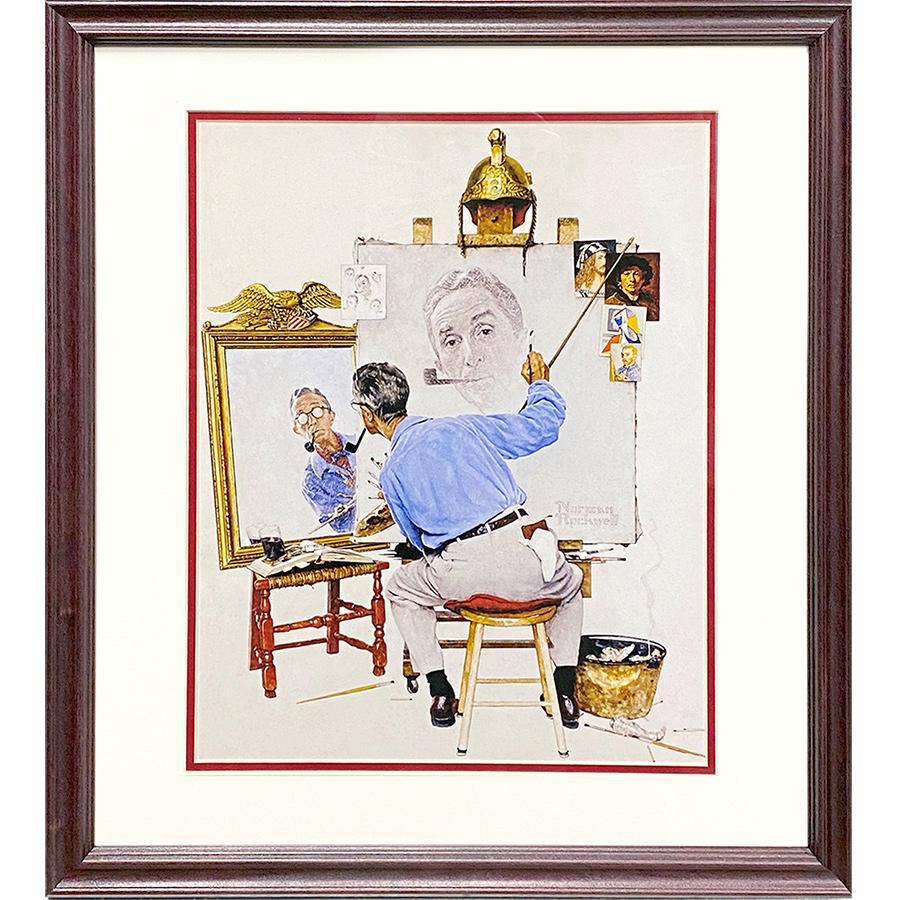
Rockwell painted his famous Triple Self-Portrait in 1960. Look at it. He's looking in a mirror, painting himself looking at himself. Three layers of observation. That's not just clever composition—that's a man who understood something about consciousness that most of us are still trying to figure out.
He started young. In the fall of 1912, an 18-year-old art student walked into the offices of Boy's Life magazine looking for work. When he left, he had his first commission. By 19, he was the magazine's art director. His first published magazine cover—"Scout at Ship's Wheel"—appeared in the September 1913 edition. He'd already been paid for his first commission—four Christmas cards—before his sixteenth birthday.
Painting was all he knew how to do. He quit high school to study art full-time. He wasn't a trust fund kid finding himself—he was a young man from New York City who knew one thing and did it with everything he had. For 64 years with the Boy Scouts alone, plus everything else.
When World War I came, Rockwell tried to enlist in the Navy. He was rejected—17 pounds underweight for someone six feet tall. So he spent one night gorging on bananas, doughnuts, and liquids. The next day, a sympathetic Navy doctor waived the rules. Rockwell was in.
He never saw combat. Instead, they stationed him at Charleston Naval Shipyard, where he did "morale work"—drawing cartoons and illustrations for the camp newspaper, Afloat and Ashore, and painting portraits of officers and sailors. He survived the 1918 Spanish Flu pandemic while stationed there. Eventually, he even moved his studio to the USS Hartford—Admiral Farragut's famous Civil War ship. He got an early discharge after painting his commanding officer's portrait.
The Navy recognized what he could do and let him go do it for the whole country.
The discipline was insane. He'd spend weeks on a single painting. Hire models. Build sets. Take hundreds of reference photographs. Then throw it all away and start over if it wasn't right.
That's not obsession. That's devotion. There's a difference.
Obsession is the monkey mind running wild, chasing perfection to avoid pain. Devotion is showing up every day because the work matters more than your comfort.
Rockwell showed up for 60 years. Through depression—he received psychiatric treatment from Erik Erikson, the renowned psychoanalyst. Through three marriages. Through critics who called him an "illustrator" like it was an insult. Through an America that kept changing underneath his brushes.
He kept looking. He kept painting what he saw.
And when what he saw got uncomfortable—when America stopped being the small-town dream and started being something harder—he painted that too.
That's the part they don't put on the coffee mugs.
"The secret to so many artists living so long is that every painting is a new adventure. So you see, they're always looking ahead to something new and exciting. The secret is not to look back." — Norman Rockwell
He died at 84 in 1978, still painting. One of his last portraits was Colonel Sanders—a man who didn't find his purpose until his 60s. There's a lesson in that choice.
The practice doesn't have an expiration date. Neither does courage. Neither does showing up.
This is the first in a series about what Norman Rockwell can teach us about mindful living. Not because he was perfect—he wasn't. But because he kept his eyes open for six decades in a culture that rewards looking away.
That's harder than it sounds. And it matters more than ever.
Support the Legacy: The painting featured in this post is available as a museum-quality print from the Norman Rockwell Museum. Every purchase directly supports the museum's mission to preserve Rockwell's true legacy—especially important now, as the family fights to protect his work from misuse. Browse prints at prints.nrm.org
