Franklin Roosevelt gave a speech in January 1941 about four essential human freedoms. It was a good speech. Abstract. Political. The kind of thing that gets quoted in textbooks and forgotten by everyone else.
Then Norman Rockwell got ahold of it.
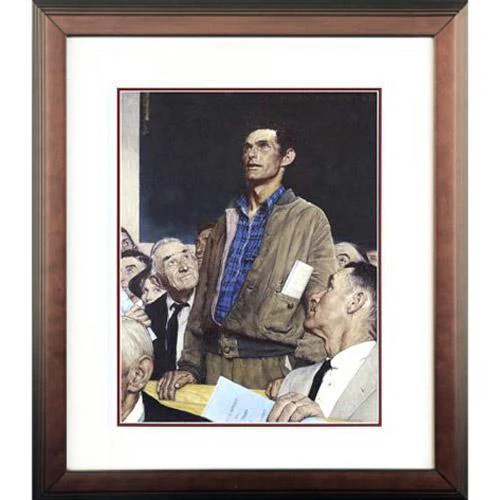
Freedom of Speech isn't a politician at a podium. It's a working man in a leather jacket standing up at a town meeting. Everyone around him is in suits. He's clearly not wealthy. His hands are rough. And everyone in that room is listening to him.
That's the freedom. Not the right to speak—the reality of being heard.
Rockwell understood something about mindfulness that most meditation teachers miss: it has to land in the body. You can't think your way to freedom. You have to feel it.
Finding new ideas for paintings never came easily, but this was a greater challenge. "It was so darned high-blown," Rockwell said. Then, by chance, he attended a town meeting where one man rose among his neighbors and voiced an unpopular view. That night Rockwell awoke with the realization that he could paint the freedoms from his own hometown experiences.
Freedom from Want is the one you've seen a thousand times—the Thanksgiving table, the grandmother with the turkey. It's been parodied endlessly. But look at the original. Look at the faces. There's no wealth on display. The tablecloth is plain. The food is simple. The freedom isn't abundance—it's enough. It's family. It's presence.
Freedom from Fear shows parents tucking children into bed. The father holds a newspaper with war headlines. The children sleep peacefully, unaware. The parents carry the weight so the kids don't have to.
That's love. That's also the practice. Holding space for difficulty without passing it on. Being present to hard truths without letting them destroy tenderness.
These four paintings toured the country with war bond drives. They raised over \$130 million. In 1943 dollars. After their publication, the Saturday Evening Post received 25,000 requests for reprints. People lined up for hours to see them. Not because they were pretty—because they were true.
That's what real mindfulness does. It doesn't describe the truth. It transmits it.
"I paint life as I would like it to be." — Norman Rockwell
Critics have used that quote against him for decades. But they miss the point. Painting life as you'd like it to be isn't denial. It's vision. It's the first step of any transformation—seeing clearly what could exist.
The Four Freedoms weren't lies. They were invitations. Rockwell was saying: This is possible. This is worth fighting for. This is who we could be.
Eighty years later, we're still trying to live up to those paintings. That's not failure. That's how change works. Slowly. Imperfectly. One brushstroke at a time.
Own a Piece of History: The Four Freedoms series is available as museum-quality prints from the Norman Rockwell Museum. Your purchase supports the museum's work preserving Rockwell's legacy. Shop at prints.nrm.org
