Her name was Ruby Bridges. She was six years old. On November 14, 1960, she became the first Black child to integrate an all-white elementary school in the South—William Frantz Elementary in New Orleans.
She had to be escorted by four federal marshals.
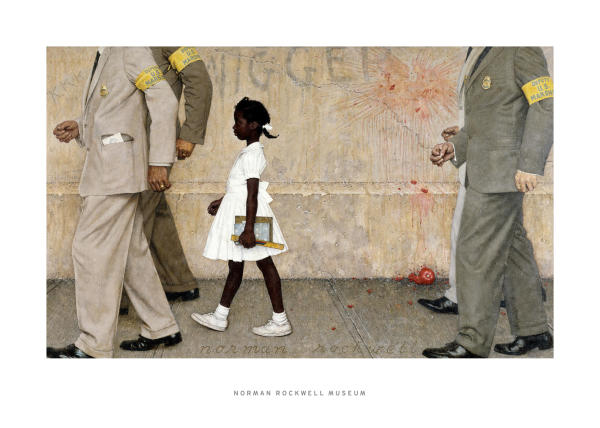
Look at Rockwell's painting.
The marshals' faces are cropped out. You can't see them. They're not the point. The point is the tiny girl in the white dress, carrying her school supplies, walking forward. The point is the n-word scrawled on the wall behind her. The point is the tomato splattered like blood.
This is not "life as I would like it to be." This is life as it was. As it is. As it might still be if we look away.
Norman Rockwell was 70 years old when this appeared in Look magazine on January 14, 1964—a year that marked the 10th anniversary of Brown v. Board of Education. After decades of showing America its idealized self, he finally showed it the truth.
Ruby Bridges didn't choose to be a symbol. She just wanted to go to school. As she describes it, "Driving up I could see the crowd, but living in New Orleans, I actually thought it was Mardi Gras."
Former U.S. Deputy Marshal Charles Burks later recalled, "She showed a lot of courage. She never cried. She didn't whimper. She just marched along like a little soldier."
The letters poured in.
A Florida reader wrote: "Rockwell's picture is worth a thousand words… I am saving this issue for my children with the hope that by the time they become old enough to comprehend its meaning, the subject matter will have become history."
A Tennessee man named Chester Martin wrote directly to Rockwell: "I have never been so deeply moved by a picture… Thank you for showing this white Southerner how ridiculous he looks."
But others were furious. A man from Texas wrote: "Just where does Norman Rockwell live? Probably in an all-white, highly expensive, highly exclusive neighborhood. Oh what hypocrites all of you are!"
A man from New Orleans called it "just some more vicious lying propaganda being used for the crime of racial integration."
"Here was a man that had been doing lots of work, painting family images, and all of a sudden decided this is what I'm going to do…it's wrong, and I'm going to say that it's wrong." — Ruby Bridges, on Norman Rockwell
Ruby Bridges is still alive. On July 15, 2011, she met President Obama at the White House, and they looked at Rockwell's painting together. "I think it's fair to say that if it hadn't been for you guys, I might not be here and we wouldn't be looking at this together," Obama told her. The painting hung in the West Wing from June through October 2011.
The problem we all live with hasn't been solved. Rockwell knew it wouldn't be. But he painted it anyway. Because that's what artists do. They show us ourselves, and then they trust us to do something with what we see.
What are you going to do?
Support the Legacy: The Problem We All Live With is available as a museum-quality print. This is the painting that hung in the Obama White House. Own it. Display it. Keep the conversation going. prints.nrm.org
