In 2025, the Department of Homeland Security launched campaigns featuring Norman Rockwell imagery. Small-town America. The Statue of Liberty. Workers cleaning Lady Liberty's torch. The message: "Protect your homeland. Defend your culture." The implication: this is what America looks like. These other people don't belong.
Norman Rockwell's granddaughter, Daisy Rockwell—herself a writer and artist—organized the family's response: a letter denouncing the unauthorized use of their patriarch's work.
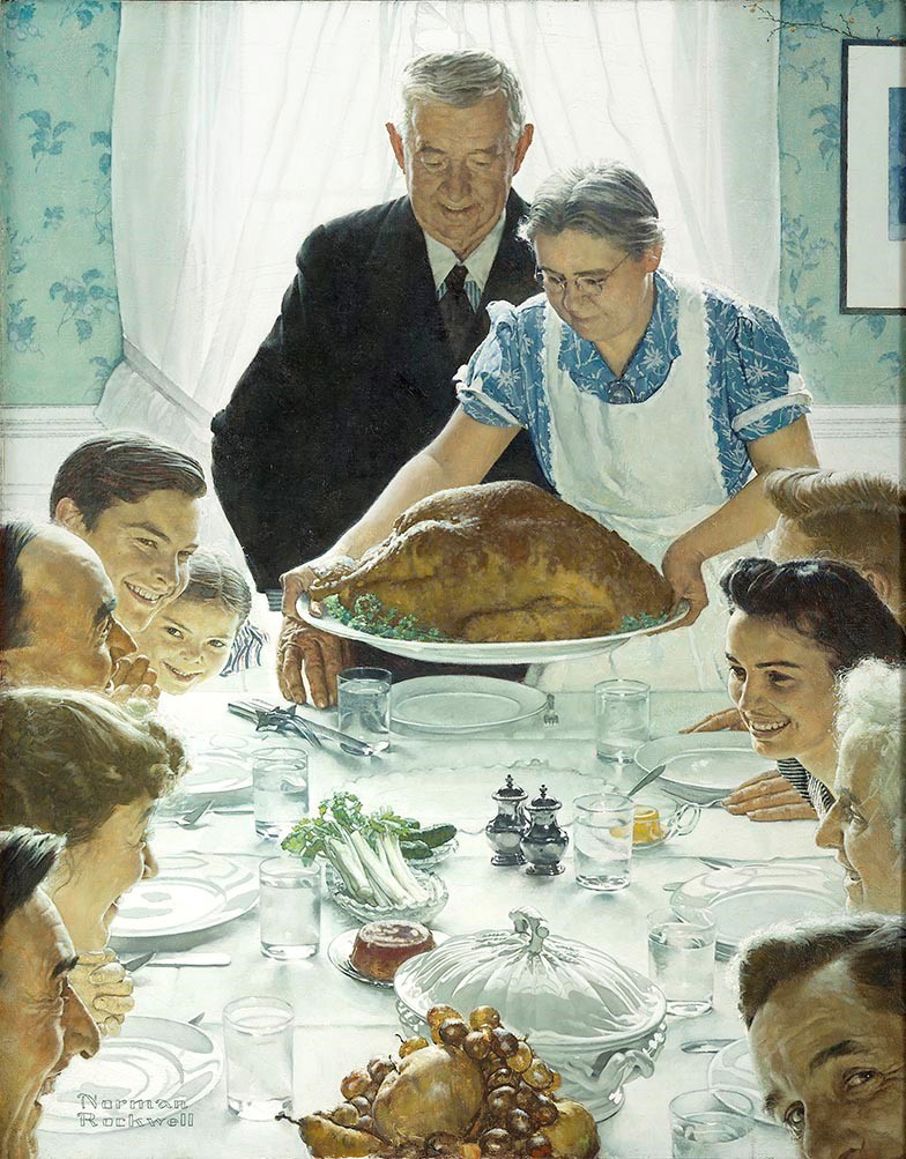
In an interview with Catherine Rampell for The Bulwark, Daisy walked through the Norman Rockwell Museum explaining what her grandfather actually believed—and how his images were being twisted into something he would have despised.
Let me be clear about something: Norman Rockwell painted Freedom from Want—the Thanksgiving dinner everyone's seen—in 1943 as part of his Four Freedoms series. That series wasn't about excluding people. It was about including them. The whole point was that these freedoms belonged to everyone. That was why they were worth fighting for.
Here's the irony that should make your blood boil: Rockwell's government imagery was designed to rally Americans together. The Four Freedoms toured the country and raised $132 million in war bonds—not by threatening people, but by reminding them what they shared. His iconic painting "The Runaway" shows a state trooper sitting next to a kid at a diner counter. No handcuffs. No interrogation. Just a cop buying a boy a meal and having a conversation. That's what Rockwell thought government could be: a trusted neighbor, not an occupying force.
Now compare that to DHS slapping his art on propaganda with messages like "PROTECT YOUR HOMELAND" and "DEFEND YOUR CULTURE." The same government that once used Rockwell to unite Americans is now using him to divide them. The trusted cop became "obey or die." The Thanksgiving table became "these people don't belong here."
Rockwell painted government servants as servants—compassionate, present, human. DHS turned them into enforcers. That's not just a misuse of his art. It's a betrayal of everything he spent his life showing us government could be.
Using Rockwell's art to promote exclusion isn't just legally questionable. It's a desecration. It takes images created to expand our sense of who belongs and uses them to contract it.
"He would have been appalled. This goes against everything he stood for. Everybody in the family is outraged." — Daisy Rockwell
This is why context matters. This is why history matters. This is why we can't let the loudest voices define what things mean.
Norman Rockwell spent the last decade of his career painting civil rights imagery. He resigned from the Saturday Evening Post because they wouldn't let him show America's diversity. He painted Ruby Bridges and the murdered civil rights workers and integration as a beautiful thing.
At the museum, Daisy pointed out places where he sneaked in nonwhite characters anyway—always in ways to emphasize their common humanity. In the Statue of Liberty painting DHS appropriated, the team of workmen cleaning Lady Liberty's torch is racially integrated.
"I was born a White Protestant with some prejudices that I am continuously trying to eradicate," Rockwell said in 1962. "I am angry at unjust prejudices, in other people and in myself."
It's not enough to know what you stand for. You have to protect it. You have to show up, again and again, and refuse to let your work be twisted into something it was never meant to be.
Daisy Rockwell is doing that. Fighting to protect her grandfather's legacy from people who want to use it against everything he believed.
There's a through-line here. Norman walked away from the Post at 70 rather than compromise his art. His granddaughter is fighting to protect what he built.
The practice continues. The pause between stimulus and response. The choice to act with integrity even when it would be easier not to.
What will you protect?
Take Action: The Rockwell family is fighting to protect Norman's legacy from misuse. Support them by purchasing prints directly from the Norman Rockwell Museum—not from unauthorized sellers. Every dollar goes to preserving his true vision. prints.nrm.org
